Banana Milo Ice Cream by Riceype


The History of Ice Cream

The Evolution of Ice Cream

Ice cream's origins are known to reach back as far as the second century B.C., although no specific date of origin nor inventor has been undisputably credited with its discovery. We know that Alexander the Great enjoyed snow and ice flavored with honey and nectar. Biblical references also show that King Solomon was fond of iced drinks during harvesting. During the Roman Empire, Nero Claudius Caesar (A.D. 54-86) frequently sent runners into the mountains for snow, which was then flavored with fruits and juices.
Over a thousand years later, Marco Polo returned to Italy from the Far East with a recipe that closely resembled what is now called sherbet. Historians estimate that this recipe evolved into ice cream sometime in the 16th century. England seems to have discovered ice cream at the same time, or perhaps even earlier than the Italians. "Cream Ice," as it was called, appeared regularly at the table of Charles I during the 17th century. France was introduced to similar frozen desserts in 1553 by the Italian Catherine de Medici when she became the wife of Henry II of France. It wasn't until 1660 that ice cream was made available to the general public. The Sicilian Procopio introduced a recipe blending milk, cream, butter and eggs at Café Procope, the first café in Paris.

Ice Cream for America

The first official account of ice cream in the New World comes from a letter written in 1744 by a guest of Maryland Governor William Bladen. The first advertisement for ice cream in this country appeared in the New York Gazette on May 12, 1777, when confectioner Philip Lenzi announced that ice cream was available "almost every day." Records kept by a Chatham Street, New York, merchant show that President George Washington spent approximately $200 for ice cream during the summer of 1790. Inventory records of Mount Vernon taken after Washington's death revealed "two pewter ice cream pots." President Thomas Jefferson was said to have a favorite 18-step recipe for an ice cream delicacy that resembled a modern-day Baked Alaska. Check out President Jefferson's vanilla ice cream recipe here. In 1813, Dolley Madison served a magnificent strawberry ice cream creation at President Madison's second inaugural banquet at the White House.
Until 1800, ice cream remained a rare and exotic dessert enjoyed mostly by the elite. Around 1800, insulated ice houses were invented. Manufacturing ice cream soon became an industry in America, pioneered in 1851 by a Baltimore milk dealer named Jacob Fussell. Like other American industries, ice cream production increased because of technological innovations, including steam power, mechanical refrigeration, the homogenizer, electric power and motors, packing machines, and new freezing processes and equipment. In addition, motorized delivery vehicles dramatically changed the industry. Due to ongoing technological advances, today's total frozen dairy annual production in the United States is more than 1.6 billion gallons.
Wide availability of ice cream in the late 19th century led to new creations. In 1874, the American soda fountain shop and the profession of the "soda jerk" emerged with the invention of the ice cream soda. In response to religious criticism for eating "sinfully" rich ice cream sodas on Sundays, ice cream merchants left out the carbonated water and invented the ice cream "Sunday" in the late 1890's. The name was eventually changed to "sundae" to remove any connection with the Sabbath.
Ice cream became an edible morale symbol during World War II. Each branch of the military tried to outdo the others in serving ice cream to its troops. In 1945, the first "floating ice cream parlor" was built for sailors in the western Pacific. When the war ended, and dairy product rationing was lifted, America celebrated its victory with ice cream. Americans consumed over 20 quarts of ice cream per person in 1946.
In the 1940s through the ‘70s, ice cream production was relatively constant in the United States. As more prepackaged ice cream was sold through supermarkets, traditional ice cream parlors and soda fountains started to disappear. Now, specialty ice cream stores and unique restaurants that feature ice cream dishes have surged in popularity. These stores and restaurants are popular with those who remember the ice cream shops and soda fountains of days past, as well as with new generations of ice cream fans.
Top 4 Kanin Hacks


History of rice cultivation

Oryza sativa was domesticated from the wild grass Oryza rufipogon roughly 10,000–14,000 years ago. The two main subspecies of rice – indica (prevalent in tropical regions) and japonica (prevalent in the subtropical and temperate regions of East Asia) – are not believed to have been derived from independent domestication events. Another cultivated species, O. glaberrima, was domesticated much later in West Africa.
Recent genetic evidence show that all forms of Asian rice, both indica and japonica, come from a single domestication event that occurred 8,200–13,500 years ago in the Pearl River valley region of China.
In China, extensive archeological evidence points to the middle Yangtze and upper Huai rivers as the two earliest places of O. sativa cultivation in the country. Rice and farming implements dating back at least 8,000 years have been found. Cultivation spread down these rivers over the following 2,000 years. 
Puddling the soil – turning it to mud to break it down and prevent too much water percolating away – and transplanting seedlings were likely refined in China. Both operations became integral parts of rice farming and remain widely practiced to this day. With the development of puddling and transplanting, rice became truly domesticated. 
Movement to western India and south to Sri Lanka was also accomplished very early. Rice was a major crop in Sri Lanka as early as 1000 B.C. The crop may well have been introduced to Greece and the neighboring areas of the Mediterranean by returning members of Alexander the Great’s expedition to India around 344-324 B.C. From a center in Greece and Sicily, rice spread gradually throughout southern Europe and to a few locations in northern Africa. 
As a result of Europe’s great Age of Exploration, new lands to the west became available for exploitation. Rice cultivation was introduced to the New World by early European settlers. The Portuguese carried it to Brazil and the Spanish introduced its cultivation to several locations in Central and South America. The first record for North America dates from 1685, when the crop was produced on the coastal lowlands and islands of what is now South Carolina. It is thought that slaves from West Africa who were transported to the Carolinas in the mid-18th century introduced the complex agricultural technology needed to grow rice. Their labor then insured a flourishing rice industry. By the 20th century, rice was produced in California’s Sacramento Valley. The introduction into California corresponded almost exactly with the timing of the first successful crop in Australia’s New South Wales. 

Regional development of rice cultivation

Asia

Based on archeological evidence, rice was believed to have first been domesticated in the region of the Yangtze River valley in China. Morphological studies of rice phytoliths from the Diaotonghuan archaeological site clearly show the transition from the collection of wild rice to the cultivation of domesticated rice. The large number of wild rice phytoliths at the Diaotonghuan level dating from 12,000–11,000 BP indicates that wild rice collection was part of the local means of subsistence. Changes in the morphology of Diaotonghuan phytoliths dating from 10,000–8,000 BP show that rice had by this time been domesticated.[28] Soon afterwards the two major varieties of indica and japonica rice were being grown in Central China. In the late 3rd millennium BC, there was a rapid expansion of rice cultivation into mainland Southeast Asia and westwards across India and Nepal.
In 2003, Korean archaeologists claimed to have discovered the world's oldest domesticated rice. Their 15,000 year old age challenges the accepted view that rice cultivation originated in China about 12,000 years ago. These findings were received by academia with strong skepticism, and the results and their publicizing has been cited as being driven by a combination of nationalist and regional interests.In 2011, a combined effort by the Stanford University, New York University, Washington University in St. Louis, and Purdue University has provided the strongest evidence yet that there is only one single origin of domesticated rice, in the Yangtze Valley of China.
The earliest remains of the grain in the Indian subcontinent have been found in the Indo-Gangetic Plain and date from 7000–6000 BC though the earliest widely accepted date for cultivated rice is placed at around 3000–2500 BC with findings in regions belonging to the Indus Valley Civilization. Perennial wild rices still grow in Assam and Nepal. It seems to have appeared around 1400 BC in southern India after its domestication in the northern plains. It then spread to all the fertile alluvial plains watered by rivers. Cultivation and cooking methods are thought to have spread to the west rapidly and by medieval times, southern Europe saw the introduction of rice as a hearty grain.
O. sativa was recovered from a grave at Susa in Iran (dated to the 1st century AD) at one end of the ancient world, another domestication of rice in South Asia.
Today, the majority of all rice produced comes from China, India, Indonesia, Pakistan, Bangladesh, Vietnam, Thailand, Myanmar, Philippines, and Japan. Asian farmers still account for 92% of the world's total rice production.

Africa

African rice has been cultivated for 3500 years. Between 1500 and 800 BC, Oryza glaberrima propagated from its original centre, the Niger River delta, and extended to Senegal. However, it never developed far from its original region. Its cultivation even declined in favour of the Asian species, which was introduced to East Africa early in the common era and spread westward. African rice helped Africa conquer its famine of 1203.

Rest of the world

Middle East

Rice was grown in some areas of southern Iraq. With the rise of Islam it moved north to Nisibin, the southern shores of the Caspian Sea and then beyond the Muslim world into the valley of Volga. In Egypt, rice is mainly grown in the Nile Delta. In Palestine, rice came to be grown in the Jordan Valley. Rice is also grown in Yemen.

Europe

The Moors brought Asiatic rice to the Iberian Peninsula in the 10th century. Records indicate it was grown in Valencia and Majorca. In Majorca, rice cultivation seems to have stopped after the Christian conquest, although historians are not certain.
Muslims also brought rice to Sicily, where it was an important crop long before it is noted in the plain of Pisa (1468) or in the Lombard plain (1475), where its cultivation was promoted by Ludovico Sforza, Duke of Milan, and demonstrated in his model farms.
After the 15th century, rice spread throughout Italy and then France, later propagating to all the continents during the age of European exploration.The Ottomans introduced rice to the Balkans.

Caribbean and Latin America

Rice is not native to the Americas but was introduced to Latin America and the Caribbean by European colonizers at an early date with Spanish colonizers introducing Asian rice to Mexico in the 1520s at Veracruz and the Portuguese and their African slaves introducing it at about the same time to Colonial Brazil. Recent scholarship suggests that enslaved Africans played an active role in the establishment of rice in the New World and that African rice was an important crop from an early period. Varieties of rice and bean dishes that were a staple dish along the peoples of West Africa remained a staple among their descendants subjected to slavery in the Spanish New World colonies, Brazil and elsewhere in the Americas.
The Native Americans of what is now the Eastern United States may have practiced extensive agriculture with forms of wild rice. (References to wild rice in the Americas are to the unrelated Zizania palustris.)

United States

In the United States, colonial South Carolina and Georgia grew and amassed great wealth from the Slavery labor obtained from the Senegambia area of West Africa and from coastal Sierra Leone. At the port of Charleston, through which 40% of all American slave imports passed, slaves from this region of Africa brought the highest prices, in recognition of their prior knowledge of rice culture, which was put to use on the many rice plantations around Georgetown, Charleston, and Savannah. From the enslaved Africans, plantation owners learned how to dyke the marshes and periodically flood the fields. At first the rice was milled by hand with wooden paddles, then winnowed in sweetgrass baskets (the making of which was another skill brought by slaves from Africa). The invention of the rice mill increased profitability of the crop, and the addition of water power for the mills in 1787 by millwright Jonathan Lucas was another step forward. Rice culture in the southeastern U.S. became less profitable with the loss of slave labor after the American Civil War, and it finally died out just after the turn of the 20th century. Today, people can visit the only remaining rice plantation in South Carolina that still has the original winnowing barn and rice mill from the mid-19th century at the historic Mansfield Plantation in Georgetown, South Carolina. The predominant strain of rice in the Carolinas was from Africa and was known as "Carolina Gold." The cultivar has been preserved and there are current attempts to reintroduce it as a commercially grown crop.
In the southern United States, rice has been grown in southern Arkansas, Louisiana, and east Texas since the mid-19th century. Many Cajun farmers grew rice in wet marshes and low lying prairies where they could also farm crayfish when the fields were flooded. In recent years rice production has risen in North America, especially in the Mississippi River Delta areas in the states of Arkansas and Mississippi.
Rice cultivation began in California during the California Gold Rush, when an estimated 40,000 Chinese laborers immigrated to the state and grew small amounts of the grain for their own consumption. However, commercial production began only in 1912 in the town of Richvale in Butte County. By 2006, California produced the second largest rice crop in the United States, after Arkansas, with production concentrated in six counties north of Sacramento. Unlike the Mississippi Delta region, California's production is dominated by short- and medium-grain japonica varieties, including cultivars developed for the local climate such as Calrose, which makes up as much as 85% of the state's crop.
More than 100 varieties of rice are commercially produced primarily in six states (Arkansas, Texas, Louisiana, Mississippi, Missouri, and California) in the U.S. According to estimates for the 2006 crop year, rice production in the U.S. is valued at $1.88 billion, approximately half of which is expected to be exported. The U.S. provides about 12% of world rice trade. The majority of domestic utilization of U.S. rice is direct food use (58%), while 16% is used in each of processed foods and beer. The remaining 10% is found in pet food.

Australia

Rice was one of the earliest crops planted in Australia by British settlers, who had experience with rice plantations in the Americas and the subcontinent.
Although attempts to grow rice in the well-watered north of Australia have been made for many years, they have consistently failed because of inherent iron and manganese toxicities in the soils and destruction by pests.
In the 1920s it was seen as a possible irrigation crop on soils within the Murray-Darling Basin that were too heavy for the cultivation of fruit and too infertile for wheat.
Because irrigation water, despite the extremely low runoff of temperate Australia, was (and remains) very cheap, the growing of rice was taken up by agricultural groups over the following decades. Californian varieties of rice were found suitable for the climate in the Riverina, and the first mill opened at Leeton in 1951.
Even before this Australia's rice production greatly exceeded local needs, and rice exports to Japan have become a major source of foreign currency. Above-average rainfall from the 1950s to the middle 1990s encouraged the expansion of the Riverina rice industry, but its prodigious water use in a practically waterless region began to attract the attention of environmental scientists. These became severely concerned with declining flow in the Snowy River and the lower Murray River.
Although rice growing in Australia is highly profitable due to the cheapness of land, several recent years of severe drought have led many to call for its elimination because of its effects on extremely fragile aquatic ecosystems. The Australian rice industry is somewhat opportunistic, with the area planted varying significantly from season to season depending on water allocations in the Murray and Murrumbidgee irrigation regions.

History of Nilagang Baka

Boiled beef is a food form that has firm ties with the peasant class. Not having the means to buy the more expensive cuts, poor folk from Europe, Asia, or the Americas had to settle for the tougher cuts of meat for sustenance.
But these bony, sinewy parts proved to be the best for creating a deep-flavored broth, and by long simmering, the beef cartilage and collagen are broken down and become soft and gelatinous.
Among the international boiled beef dishes that still exist today, though not as popular as before, are the French pot-au-feu, the English boiled beef and carrots, and the Jewish (and Irish-American) boiled corned beef brisket.
In the Philippines, we have the Nilagang Baka and Bulalo, a specialty of the cattle-grazing provinces of Batangas and Cavite.


Throughout much of human history, cattle and most of its bovine kin were regarded as capital. (Indeed, the very word capital comes from the Latin caput, or head, of cattle.)
They were draught animals, much valued for their assistance in plowing the land, moving cartloads of goods, and of course, as a source of milk.
“An animal was not slaughtered until it was fit for nothing else,” said Maguelonne Toussaint-Samat in A History of Food.
A “gastronomic wealth of recipes” was thus born using precisely this kind of tough meat, including the classic French dish pot-au-feu.
Julia Child sings the praises of this food in Mastering the Art of French Cooking: “The potée, like all boiled dinners, is easy on the cook because it can simmer quietly by itself for four to five hours, and if it is done before serving time it can remain in its kettle where it will keep warm for a good hour.”
Her recipe for pot-au-feu is a bit grand though since it includes, not just beef, but also pork, chicken and sausage, all cooked together in an earthenware pot. (Pot-au-feu is French for cooking in a pot over fire.)
The earlier versions of   are simpler: a nod to the egalitarian ethos of the French. It would have cheap cuts of beef and vegetables that are in season including carrots, onions, turnips, celery, parsnips, and leeks.
Indeed, because boiled beef is a countryman’s dish. In England, boiled beef and carrots is known “Cockney” food, referring to the working class district  of London’s east end.
In ancient times to the Middle Ages, and indeed, up until the invention of refrigeration, beef when obtained was almost always salted and brined in order to prolong its use.
This was an essential item especially for soldiers and sailors who toiled for years in their various war campaigns and expeditions. Meat that was salted usually found a second life once it was boiled in water, and vegetables were thrown in for added flavor and nutrition.
This brings us to the story of Irish boiled bacon and cabbage. This is a traditional dish in Ireland, featuring cured and unsliced bacon,
potatoes, and cabbage.
When the Irish immigrants arrived in America they found that bacon was hard to come by, but corned beef brisket was plentiful.
A quick substitution ensued, and so now in America, especially during St. Patrick’s Day, you can partake of the Irish or Jewish versions of the boiled corned beef, or another version up the east coast called the New England Boiled Dinner (the recipe is almost the same as the Irish one, although they sometimes use pork shoulder ham).
In the Philippines, our version of the boiled beef dinner is of course Nilagang Baka. Ours, however, is a one-pot dish where we savor the soup as much as we enjoy the supple beef.
Our variations are Bulalo, wherein the fatty bone marrow is the sought after morsel; Puchero, which combines chorizo and saba (plantains) to the boiled beef shanks; and Kansi, a hybrid dish from Negros province that also uses beef marrow and shanks (like Bulalo) but also adds the local batuan fruit to bring a tartness to the soup (much like sinigang).
The European version of the boiled dinner has evolved into one wherein they scoop out the beef or other meats, slice it against the grain into serving pieces, and serve it in a plate together with the cooked vegetables. Another progression is the addition of a piquant sauce such as mustard or horseradish, or a creamier alternative like white sauce.
In contrast, we like to eat our boiled beef dishes in a plate together with steamed white rice, with a seasoning of either patis (fish sauce) or soy sauce, drizzled with the local lime calamansi. We also love to have a separate bowl of the beef soup on the side, to slurp down in between mouthfuls of the tender beef.
There are only two key things to remember in making a good Nilagang Baka.
One is to make sure to include some beef bones (marrow, or kneecaps) together with the stewing meat (shank or otherwise), and second, to maintain a gentle simmer over the soup for several hours, or until the meat is tender.
Avoid though a rolling boil that will only make the meat tough and stringy.
Ingredients:
2 kilos combination of beef bones (marrow, kneecaps, or brisket bone-in) and stewing beef or shanks
1 yellow onion, sliced
1-inch ginger, sliced
3 potatoes, peeled and quartered
250 grams Baguio beans, trimmed and sliced diagonally
1 small cabbage, quartered
1-2 tablespoons salt
1 teaspoon whole black peppercorns
Method:
Place the meat and bones in a deep pot, add the onions, ginger, whole peppercorns, and enough water to cover meat. As it comes to a boil, skim off the scum. Lower the heat, cover, and simmer until the meat is tender, about three hours. (If using bulalo, remove it when cooked so that the marrow doesn’t spill out of the bone.)
Add the potatoes and salt. When the potatoes are done, place the cabbage on top of the soup and cook for a further five minutes.
Return the cooked bone marrow to the soup. Add the Baguio beans and cook for two minutes. Taste the soup and adjust the seasoning. Serve hot with rice and fish or soy sauce on the side.

20 INTERESTING LECHÓN FACTS

1. Lechón is a pork dish and is a national dish of Philippines and Puerto Rico.
2. This dish is extremely popular in various countries like Dominican Republic, Canada, Puerto Rico, Cuba, Philippines, Spain and various other Spanish-speaking Latin American nations.
3. Lechón is actually a Spanish word which means roasted suckling pig.
4. This dish is prepared by roasting a whole suckling pig over charcoal.
5. Cebu in Philippines is source for best quality suckling pigs in entire world. Cebu is an island province located in Philippines. It is one of the most developed provinces in Philippines.
6. In many Latin American countries, the immense popularity of the dish has use of medium-sized adult pigs instead of suckling pigs.
7. Lechón preparation takes nearly 8 hours.
8. Lechón has a unique preparation process. The suckling pig is first killed and then its belly is slit lengthwise from hind legs to front legs. Ears, tail and feet are all left intact.
9. Hair from the pig’s body is carefully shaved off. It is usually done by the butcher but some hair may still stay on the body. It is essential to carefully inspect the pig and remove any remaining hair before seasoning it.
10. Once the raw pig is thoroughly cleaned and washed, it is seasoned with crushed garlic, dried oregano, black pepper, salt and achiote oil. The amount of seasoning to be used usually depends on the size of the pig and it should be seasoned both inside and outside. For a 100 lb. pig, the seasoning should be used in following ratio:
  • Achiote oil – 7 cups.
  • Salt – ¾ cup.
  • Black pepper – 1 cup.
  • Dried oregano – 1 cup.
  • Crushed garlic – 2 cups.
11. After thorough seasoning, the pig is refrigerated in a large tub with ice.
12. The pig is then skewered and attached to a metal rod and is placed in a large pit full of charcoal. It is very essential to use charcoal that does not have lighter fluid added to it.
13. The rod to which the pig is attached is then turned over the burning charcoal in rotisserie action. This allows even roasting.
14. This particular cooking method makes the skin of the pig very crisp which is known for its distinctive taste.
15. Charcoal roasting gives Lechón a distinctive smoky flavor.
16. The pig is roasted for around 8 hours. Once roasting is completed, the pig is allowed to sit for 20-30 minutes before cutting it. This allows the juices to sink inside, making the meat moist and soft. This is known as basting.
17. As far as nutrition is concerned, 100 grams of Lechón consists of 6 g monounsaturated fat, 1 g polyunsaturated fat, 5 g saturated fat and the total cholesterol content in 100 grams of Lechón is 95 mg.
18. 100 g of the dish contains a total of 62 mg sodium, 423 mg potassium and 27 g protein.
19. Vitamin C content is 1%, iron content is 7% and calcium content is 2% in every 100 g of Lechón.
20. The total number of calories present in 100 g or 1 serving of Lechón is 242.
Sounds yummy right? If you ever get a chance to taste this amazing dish, don’t let it go. Your taste buds will carry the taste of Lechón for a long long time!

History of Sinigang by taylormaighdlin

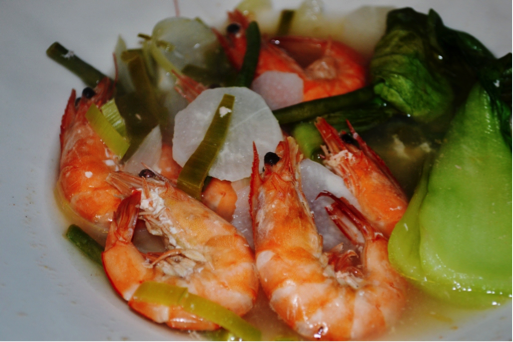
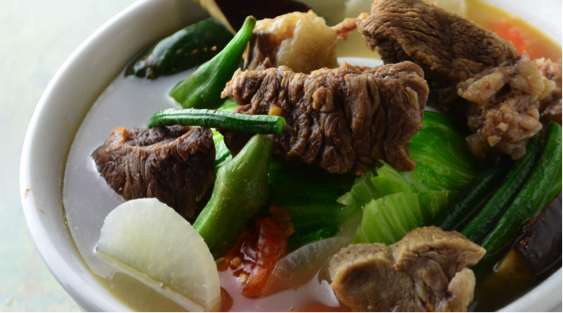
Sinigang, a sour tasting soup originating from the Philippines, is usually served as a main dish with rice. Many people make this dish for special occasions such as a birthday or a baptism, but its not for any special purpose, just a common dish of the Filipino culture. Sinigang is often composed of a type of meat or fish, vegetables, tomatoes, and tamarind flavoring. For example sinigang can be cooked with beef, chicken, pork spare ribs, shrimp, or even fish, but more commonly it is cooked with pork. Vegetables can be bok choy, string beans, broccoli, okra, taro, kangkong, or eggplant can be used, but is usually cooked with bok choy. My family in particular has made sinigang using pork spare ribs, bok Choy, tomato, and onion using the tamarind fruit powder flavoring to add the sour taste to the soup because that is how it was made where they are from, Manila. Over time, sinigang has evolved in where it has gotten it sour taste from; according to Scribd, people now use guava, raw mango, or calamansi to add the sour taste to their soup instead of just the tamarind flavoring.
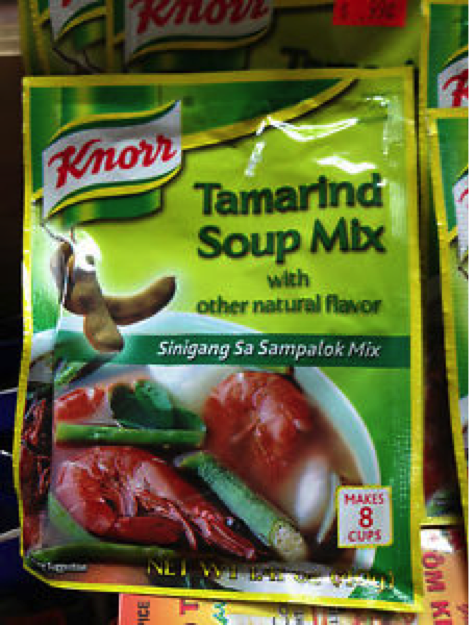
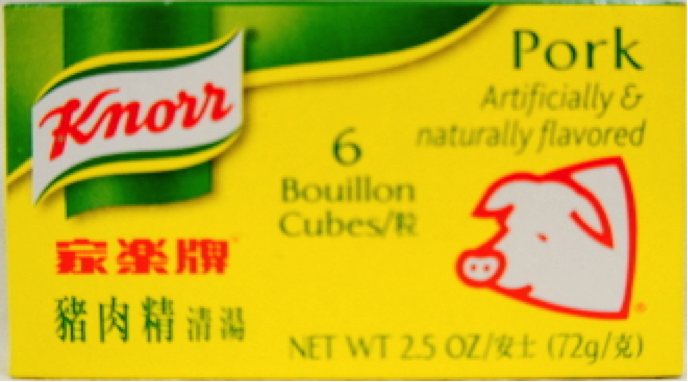
Sinigang is often assumed to be the national food of the Philippines because of how common and how long it has been around, but it is in the top ten of the Filipino specialties along with lechon, adobo, and lumpia. This dish is called sinigang because that specific word means stew which is exactly what the dish is. This stew can be helpful for a sore throat or even on a cold night to keep you warm. My Lola has often described the dish as being the food to bring people together, their little piece of home they get to eat whenever it’s made. Different regions in the Philippines cook this dish differently – Legazpi City makes this dish with fish (fish head in particular), with beef in Makati City, and with chicken in Kawit a province of Cavite, Philippines. Over time, the tamarind flavoring has evolved as well; . Over time, the tamarind flavoring has evolved as well; The fruit is no longer used and now there is a tamarind powder flavoring or tamarind bouillon cubes. Initially you were supposed to allow the tamarind fruit to boil in water until the shell came off then allow the fruit to soak in the water, which would give the broth the sour flavor. These steps can now be avoided simply by using the powder soup mix or the bouillon cubes that offer equal the taste.    
This food is authentic because of the way it has been made over the course of time. While the flavoring to make the food sour has changed, the taste has not. While different ingredients have been used, that’s how its always been, there are different ways to make sinigang depending on the region of the Philippines you are from, but nothing has changed drastically for this common Filipino dish.

History of Adobo by pepper.ph

Symbols play a huge part in Filipino culture. We have the carabao as our national animal, the sampaguita as our national flower, Manny Pacquiao as our pambansang kamao, and Sandara Park as our national krung-krung, but our food-loving country has yet to select a national dish. Considering how we have so many different regional delicacies, with each as delectable as all the others, it’d be pretty tough to come to a consensus. One dish sure comes pretty close though:  the classic adobo.

What is adobo, exactly?

Just about every Filipino loves adobo, from the call center agent with his packed Tupperware to the socialite lunching at the latest fusion place in Serendra.  There are as many versions of adobo as there are households, but all of them share the same basic components.
The dish by which every Filipina matriarch judges her daughter-in-law.
In English, adobo means “vinegar-braised.” Evenly-cut chunks of meat are first seared in hot fat or oil until they brown. Braising liquids, such as vinegar and soy sauce, are then added, and the mixture is left to simmer over low heat. The moist heat gently penetrates the meat to break down the collagen and tough fibers, resulting in a fork-tender texture with a thick, flavorful sauce. It’s a cooking method that’s time-consuming but undeniably rewarding.
While the cooking process sounds relatively simple, there are still a few details that can trip up a beginner. Remember that tougher cuts of meat need to simmer for a longer time. Tender meats like poultry or seafood should be braised in less liquid, at a lower temperature, and for a shorter period of time or they’ll disintegrate. Keep the temperature low to prevent the outer layers of the meat from toughening up before the insides are cooked thoroughly. Getting a good, even sear on the meat is also crucial to the adobo’s flavor. Lastly, salt should be added (if at all) only towards the end of the cooking process to prevent the reduced sauce from being too salty.

Filipino or Spanish? Adobo‘s Disputed Origins

The word adobo is derived from the Spanish word adobar, which means “marinade” or “pickling sauce.” The existence of the tangy dish was first recorded in 1613 by the Spaniard Pedro de San Buenaventura. In the dictionary he was compiling, Buenaventura listed the tart viand as “adobo de los naturales” for its similarity to Spanish and Mexican dishes that went by the same name. But while our favorite ulam’s moniker boasts of a pure Spanish lineage, little else about our adobo can and should be attributed to our Hispanic conquerors. According to the food historian Raymond Sokolov, the ingredients for adobo already existed in the Philippines before Ferdinand Magellan even laid eyes on our shores. Because the dish’s original name was never recorded (and in a case of what Sakolov calls “lexical imperialism”), the Spanish label stuck.
“We came up with the adobo first, foul Spaniard!”
Like many cultures based in warm climates, Filipino natives developed various methods of preserving food. They cooked using moist-heat methods like steaming or boiling. To keep their edibles fresh for a longer period, they used plenty of vinegar and salt since the elevated acidity and high sodium content produced a hazardous environment for spoilage-causing bacteria. The Chinese traders who later visited our islands introduced soy sauce to early Filipinos. It soon found its way into our nameless vinegar-braised dish, eventually displacing salt altogether.
While our adobo shares its name with a couple of Hispanic dishes, there are key differences between the Filipino version and its Spanish and Mexican cousins. The Spanish adobo sauce is distinctly spiced and fiery, with at least three kinds of chili peppers, tomato paste, and cinnamon among its ingredients while the Mexican rendition uses lemon juice, cumin, and Mexican oregano. On the other hand, the Filipino adobo base is comprised almost exclusively of vinegar, which not only flavors but also tenderizes the meat.

The Many Faces of Adobo

“When life gives you squid, make adobong pusit.”
For nearly five centuries, Filipinos have been coming up with their own new and unique takes on this classic. Here are a few of the more popular ones:
  • Chicken Pork Adobo – This is the “standard” version served in homes and carinderias across the country. Soy sauce gives it a dark color and salty flavor. Traditionally, it’s eaten the day after it’s made, once all the flavors have mixed, reabsorbed, and intensified. Since it involves two kinds of meat, the pieces of chicken are removed from the pot once they’re done, leaving the pork chunks to finish stewing.
  • Beef/Chicken/Pork Adobo – This more decadent spin on the classic stew originated in Batangas, where achuete (annatto) water is sometimes substituted for the soy sauce. This results in a less salty sauce and adds a reddish tinge to the dish. The meat is braised in order of toughness, with the hardier beef pieces hitting the pan first.
  • Adobo sa Gata – A popular dish in Southern Luzon, this Bicolano take on adobo adds coconut milk to the vinegar braising liquid. Green finger chili peppers, which abound in Bicol, are used instead of black peppercorns.
  • Adobong Puti (White Adobo) – Although this dish is actually brown (an effect of frying the meat prior to braising), it gets its name from the clear vinegary liquid it’s traditionally made with. This version is preferred by the purists since it eliminates the soy sauce and the laurel leaves from the recipe, giving way to the three basic adobo flavors: vinegar, garlic, and peppercorns.
  • Adobong Puso ng Saging – This delicacy calls for sliced white banana flowers sautéed in white vinegar, a helping of bagoong (shrimp paste), and a sprinkling of suahe (small shrimps). Hailing from Cavite, this vegetable-based adobo is used as the main souring agent in the province’s version of pancit guisado.
  • Adobong Malutong (Crispy Adobo) – Proving that Filipinos are highly resourceful when it comes to recycling leftovers, adobong malutongentails shredding the meat from leftover chicken and pork adobo , and frying them in hot oil until they are brown and crisp. Crunchy adoboflakes are known for their long shelf-life (especially when refrigerated in a sealed container) and for their versatility (they are paired with everything from kare-kare to lugaw).
  • Adobong Pusit (Squid Adobo) – Originating from coastline areas where seafood is plentiful but meat is scarce, this particular adobo’s sauce is blackened further by pouring squid ink into the stew along with vinegar and soy sauce. Green finger chili peppers are sometimes added for an extra kick.
  • Apan-apan Adobabo – This Ilonggo dish uses kangkong (water spinach) as its main attraction. This version is inherently vegetarian, but is occasionally made decadent with the addition of tulapo (bits of pork fat rendered in oil).

Adobo in the 21st Century

These days, our iconic Filipino dish is just like the half-breed starlets that abound in local showbiz: born of a surprisingly beautiful union between East and West, and thrilling to Filipinos everywhere. Take the crispy adobo flakes, for example. Instead of simply serving them on top of steaming white rice, you can now enjoy them in sandwiches, salads, and pasta dishes.  I even read about a group of young Filipino entrepreneurs who came up with sushi rolls filled with adobo flakes. And if you like your shredded meat with a nice, caramelized finish, I would suggest starting with Pepper.ph’s very own reinvention of the home-cooked meal.
Our adobo is even starting to make waves in places as far as the Big Apple. At Romy Dorotan’s Brooklyn restaurant, Purple Yam, the adobo (made with rice vinegar, coconut milk, soy sauce, garlic, and fiery Thai chilies) has been hailed by critics for its alternating notes of fragrant garlic, fiery chili, and sweet-salty nuttiness.
Maybe they use Wagyu beef and Kurobuta pork in the White House version of the adobo.
Sheldon Simeon, a Filipino-American chef from Hawaii, made a splash during the recently concluded season of Top Chef. For the finale, Simeon’s offering included his tasty riff on the much-loved Pinoy classic: tender pork belly with mung bean puree and a pea shoot salad. Judge Tom Colicchio ended up praising it for its harmonious flavors and calling it “a very good, strong dish.”
Apparently, even the leader of the free world is a fan of our savory stew. But I suppose that’s only natural, especially when the executive chef to the Obamas happens to be Cristeta Comerford, the first Filipina (as well as the first Asian-American) to hold the position. Though, with the health-conscious Michelle Obama calling the shots in that kitchen, the members of the First Family probably enjoy their adobo without the chicken skin and with less soy sauce.
They say that Filipino food was prepared by Malay settlers, spiced by the Chinese, stewed by the Spanish, and hamburgerized by the Americans. I guess that just proves that we Filipinos are quite good at adapting to change, and making the most out of our situation in order to come up with something that’s uniquely our own.
How do you like your adobo? Does your mom or lola’s recipe knock everyone else’s out of the running? Do you think it should be our national dish? Would you give Shelon Simeon’s or Purple Yam’s version a try? Sound off below!

REFERENCES:

Fenix, Michaela (ed.). (2008). Kulinarya: A Guide Book to Philippine Cuisine. Anvil: Pasig.
Fernandez, D. (1994). Tikim: Essays on Philippine Food and Culture. Anvil: Pasig.
Sta. Maria, Felice. (2006). The Governor-General’s Kitchen: Philippine Culinary Vignettes and Period Recipes, 1521-1935. Anvil: Pasig.
http://www.pepper.ph/the-history-of-adobo/
CTTO